 New Jersey Institute of Technology (NJIT) is not an Ivy. It is something a lot of students & their parents are actually looking for: a public research university with elite salary outcomes, a Manhattan-adjacent address, and a fee that does not require loans or remortgaging the house.
The case, in receipts
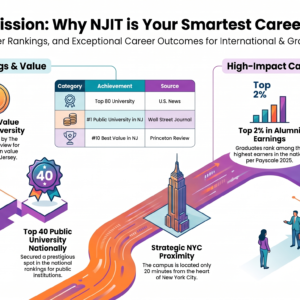
#80 | among all US national universities — NJIT’s highest placement ever, up 23 places in five years | U.S. News, 2026 |
#25 | in the United States for alumni salaries; #1 among New Jersey public universities | WSJ/College Pulse, 2026 |
Top 2% | of all US colleges for return on investment | Payscale |
$92k | median alumni earnings four years after leaving; 4.5 of 5 stars, the highest rating given to any NJ public university | Money, 2026 |
#34 | nationally for social mobility — a 10-place jump in one year | U.S. News, 2026 |
#10 | among US public universities for career placement | Princeton Review |
Why return on investment is now the only question worth asking
A decade ago, students asked us about campus beauty and society life. They do not any more. The first question in almost every consultation now is some version of: if I spend this much, what do I get back, and how fast?
That is a fair question, and it reframes the whole shortlist. Prestige is a lagging indicator — it tells you what a university was worth to graduates who left twenty years ago. Earnings data, employment rates and visa outcomes are leading indicators. They tell you what the degree is worth to someone graduating now.
Judged on the second set of numbers rather than the first, New Jersey Institute of Technology performs well above what its name recognition would predict. That gap between reputation and results is exactly where good value sits, and it is why NJIT sits on so many of our shortlists.
NJIT at a glance
Founded | 1881, as Newark Technical School; renamed NJIT in 1975 |
Type | Public polytechnic research university, Carnegie R1 (highest research activity) |
Location | Newark, New Jersey — a 48-acre campus, roughly half an hour from Midtown Manhattan by train |
Students | Around 12,000–13,000 in total, from more than 70 countries |
Class of 2030 | More than 1,900 first-year students — the largest intake in the university’s history |
Staff ratio | Approximately 16:1 |
Programmes | 125+ across engineering, computing, architecture and design, management, science and applied sciences |
Accreditation | Middle States Commission on Higher Education (MSCHE); engineering programmes ABET-accredited |
Selectivity | Acceptance rate around 65% — accessible, but not a soft option once you are inside |
What NJIT actually teaches — and why the subject mix matters
NJIT is a polytechnic, and that focus is the engine behind the salary numbers. It is not a general university that happens to have an engineering faculty. Nearly everything on offer sits in a field where employers are short of people.
Teaching is organised across six colleges and schools: Newark College of Engineering, Ying Wu College of Computing, Hillier College of Architecture and Design, Martin Tuchman School of Management, the College of Science and Liberal Arts, and the Albert Dorman Honors College.
The programmes our clients ask for most:
- MS Computer Science — the single largest destination for South Asian applicants
- MS Data Science and MS Artificial Intelligence
- MS Cybersecurity and Privacy
- MS Electrical, Mechanical, Civil and Biomedical Engineering
- MS Power and Energy Systems — strong industry links, less crowded than CS
- BS Computer Science, Engineering and Architecture at undergraduate level
The university has also put real money behind artificial intelligence. Its Grace Hopper AI Research Institute, created with an investment of more than $10 million, houses the Center for AI Research and the Institute for Data Science. For anyone weighing an AI or data programme, that matters more than a module list: it signals funded laboratories, doctoral supervision, and research assistantships you can actually apply for.
The visa question: why STEM designation changes the maths
For international students, a degree is also an immigration instrument, and this is where NJIT’s subject mix pays a second dividend.
Almost all of NJIT’s engineering, computing and science degrees are STEM-designated. In practice, that means a graduate on an F-1 visa can apply for 12 months of Optional Practical Training (OPT), then apply to extend it by a further 24 months — up to 36 months of legal work authorisation in the United States after graduation.
Three years is not a detail. It is three full hiring cycles, three chances at the H-1B lottery, and enough runway for an employer to see the value in sponsoring you. A non-STEM degree gives you twelve months and one lottery attempt. This single variable does more to determine whether a US degree “works out” than almost anything else on a prospectus.
Check before you commit. STEM designation attaches to a specific programme code, not to a university as a whole. Before you accept an offer, ask the admissions office to confirm the CIP code for your exact programme and that it appears on the current DHS STEM designated degree program list. We verify this for every client before they pay a deposit.
Newark, and the half-hour that separates you from Manhattan
NJIT’s address does a lot of quiet work. The campus sits in Newark, minutes from Newark Penn Station, which puts Midtown Manhattan around half an hour away by train and Newark Liberty International Airport about fifteen minutes away in the other direction.
The practical effect is that internships, insight days, career fairs, professional meet-ups and interviews across the New York metropolitan area are a commute rather than a relocation. Students are not waiting for graduation to meet the industry. They are already in it by second year.
There is a cost-of-living argument too. Living in Newark while working in or near New York is substantially cheaper than living in New York, and the university’s own residence halls remove the hardest part of a first year abroad — finding somewhere to live in a city you have never visited.
We are straightforward with families about Newark: it is a working American city, not a manicured college town. Students who want a self-contained campus bubble should look elsewhere. Students who want proximity to the largest concentration of finance and technology employers on earth will find very few better-placed campuses at this price.
What it costs, honestly
Nobody is served by vague numbers, so here are indicative ones. Treat them as a planning baseline and confirm current figures with NJIT’s Bursar before you budget.
Item | Indicative annual cost (international) |
Undergraduate tuition and mandatory fees | Approximately $39,000–$40,000 |
Graduate tuition and mandatory fees (full-time) | Approximately $40,000–$41,000 |
Compulsory student health insurance | Approximately $2,000 |
Housing and food, on campus | Approximately $18,900 |
Books, supplies and personal costs | Approximately $5,000–$8,000 |
Application fee | $75 (OR No fee at all) |
Funding / Scholarship you should actually pursue
- Automatic merit scholarships. International applicants are assessed for merit awards at the point of admission, with no separate application. Awards are driven mainly by academic record and, where submitted, test scores. Strong candidates commonly see five-figure annual awards.
- Graduate assistantships. Teaching and research assistantships at master’s and doctoral level can carry a tuition waiver plus a stipend. These are awarded by academic departments, not by admissions — which means contacting faculty directly, early, with a focused email.
- On-campus employment. F-1 students may work up to 20 hours a week on campus during term. This covers living costs; it does not cover tuition, and any consultant who tells you otherwise is not being straight with you.
- Education loans. Several international lenders finance NJIT without a US co-signer. We help clients compare total cost of borrowing rather than headline interest rates.
Entry requirements and deadlines
Undergraduate | Postgraduate | |
Academic | Strong secondary school record; excellent grades in O & A levels / IB, competitive applicants typically well above a 3.0 GPA equivalent | Recognised 4 years bachelor’s (honors) degree, typically 3.0 GPA or equivalent |
IELTS | 6.0 | 6.5 |
TOEFL iBT | 79 | 79 |
Duolingo | 100 | 120 |
PTE | 53 | 57 |
SAT / ACT | Test-optional for most first-year applicants; required for the Honors College and accelerated programmes | GRE varies by department — waived for several programmes |
Also required | Personal statement, reference, transcripts, portfolio for architecture and design | Statement of purpose, references, CV, transcripts, credential evaluation where required |
NJIT admits in two intakes, Fall (September) and Spring (January), with Fall by far the larger. Undergraduate Early Action typically falls in early November and Regular Decision in early February; graduate deadlines are set by department and cluster in spring for Fall entry. Applications are filed through the Common Application or NJIT’s own portal.
Our standing advice: work backwards from the visa, not the deadline. An F-1 interview slot in a busy season can be weeks out. Applying in the first window rather than the last is the cheapest risk reduction available to you, and it costs nothing.
Is NJIT right for you? An honest filter
It is a strong fit if
- You want engineering, computing, data, AI, cybersecurity, architecture or technology management — not a broad liberal arts education.
- Employment outcomes and post-study work rights rank above campus prestige in your decision.
- You want access to the New York job market without New York rent.
- You are comparing a public university fee against private university outcomes.
Look elsewhere if
- You want humanities, law, medicine or a classic liberal arts degree.
- You want a leafy, self-contained campus town.
- You are shortlisting on brand name alone — in which case be honest that you are buying recognition, and budget for it.
Names are nice. Trajectories are better. The question is not whose logo is on the certificate — it is where you are standing three years after you receive it.
Frequently asked questions
Is NJIT a good university for international students?
Yes, particularly for STEM. It ranks #80 nationally in U.S. News 2026, sits in the top 2% of US institutions for return on investment according to Payscale, and places #25 in the country for alumni salaries in the 2026 Wall Street Journal rankings. Its STEM-designated programmes carry up to 36 months of post-study work authorisation.
Is NJIT hard to get into?
The acceptance rate is around 65%, which makes it attainable for a well-prepared applicant. The rigour is in the programme, not the gate — NJIT has a reputation for demanding coursework once you are enrolled.
How much does NJIT cost for international students?
Budget roughly $39,000–$41,000 a year for tuition and mandatory fees, plus around $19,000 for on-campus housing and food and a further $5,000–$8,000 for insurance, books and personal costs. Merit scholarships are assessed automatically at admission and reduce this meaningfully for strong applicants.
Is NJIT a STEM-designated university for OPT?
The great majority of its engineering, computing and science degrees are STEM-designated, which permits 12 months of OPT plus a 24-month extension. Always confirm the designation for your specific programme code before accepting an offer.
How far is NJIT from New York City?
The campus is in Newark, New Jersey, roughly half an hour from Midtown Manhattan by train and about fifteen minutes from Newark Liberty International Airport.
Does NJIT require IELTS?
English evidence is required where English is not your first language, but NJIT accepts several tests: IELTS 6.0 for undergraduate and 6.5 for postgraduate, TOEFL iBT 79, Duolingo 100 or 120, or PTE 53 or 57. Applicants who studied in certain countries are exempt.
Does NJIT offer scholarships to international students?
Yes. Merit awards are made at the point of admission with no separate application, and graduate applicants can additionally pursue departmental assistantships carrying tuition waivers and stipends.
Talk to someone who has placed students there
Emerging Visions advises students from application through to visa and departure. For NJIT specifically, we handle programme and STEM-code verification, scholarship positioning, assistantship outreach to faculty, financial documentation for the I-20, and F-1 interview preparation.
Book a free profile assessment at emergingvisions.co.uk. Bring your transcripts, your English test result if you have one, and your budget. We will tell you honestly whether NJIT belongs on your list.