The Sanctions Matrix: Operational Impact

The Fragility of Compliance: Why the UK’s New University Rating System Leaves No Room for Error

The Sanctions Matrix: Operational Impact

1. A New Era for UK Higher Education

In June 2026, the UK Home Office will dismantle the legacy Basic Compliance Assessment (BCA) framework, replacing it with a regulatory regime that fundamentally redefines the relationship between the state and the university. This isn’t a mere administrative update; it is the implementation of a high-stakes “Traffic Light” system (Red-Amber-Green, or RAG) designed to tighten the screws on international student recruitment. For institutions already reeling from shifting global demand, the message is unmistakable: the margin for error has effectively vanished.
 
This new framework marks a shift from periodic hurdles to a state of permanent, high-pressure surveillance. While the Home Office describes the move as a way to “work with the sector,” an investigative look at the mechanics reveals a system that offloads the burden of border control directly onto university registrars. With the first public ratings slated for a simultaneous “name and shame” release in Summer 2027, the era of quiet compliance is over. In its place is a public-facing accountability model where a single departmental slip-up can tarnish a global brand overnight.
 

2. The “Weakest Link” Rule: Why Averages No Longer Matter

The most punishing aspect of this new regime is its rejection of the aggregate. In standard academic auditing, excellence in one area typically compensates for a minor deficiency elsewhere. The RAG system explicitly kills this logic. Under the “weakest link” rule, an institution’s final rating is dictated exclusively by its lowest-performing metric. A university could boast record-breaking enrolment and perfect completion rates, but if its visa refusal rate ticks a fraction of a percentage into the “Red” zone, the entire institution is branded Red.
 
This “all-or-nothing” approach transforms every admissions officer and compliance clerk into a critical point of failure. The Home Office is no longer looking for a general standard of care; it is demanding perfection across three distinct, volatile metrics.
“Raising the BCA thresholds and introducing clearer performance ratings will… reinforce the principle that sponsorship is a privilege, not a right, and help the sector continue attracting the brightest talent while reducing opportunities for misuse of the route.” — Home Office Statement.

3. The Red Zone: A Relentless Annual Cycle

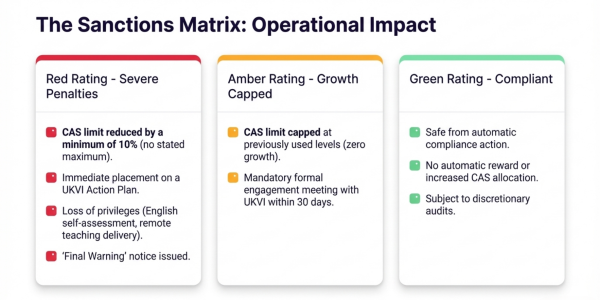
Falling into the Red category triggers a suite of draconian sanctions that threaten the very viability of international operations. A Red rating mandates an immediate UKVI action plan and a minimum 10% reduction in the institution’s Confirmation of Acceptance for Studies (CAS) allocation. Perhaps more damaging is the loss of critical “trusted sponsor” privileges, such as the ability to self-assess English language proficiency and the authority to deliver remote teaching.
 
However, the true sting lies in the “five-year final warning.” Because assessments occur on a relentless annual cycle linked to the date a license was granted, a Red rating remains a “live” threat for the next five consecutive audits. This creates a claustrophobic environment where one additional breach within a half-decade window initiates the license revocation process. To make matters worse, the Home Office has signaled a removal of the human element from the appeals process: while “exceptional circumstances” may be considered, the draft guidance states that “individual cases will not be considered” during appeals. It is a system of cold, hard numbers with no room for context.

4. The Amber Trap: Why “Yellow” is Not a Safe Haven

Institutions might be tempted to view an Amber rating as a manageable middle ground, but in reality, it is a state of punitive purgatory. An Amber rating freezes CAS growth; the UKVI will not grant a single additional CAS beyond what was previously used until the sponsor clawbacks its way to Green.
 
The Amber trap also forces a shift in institutional hierarchy. Within 30 days of notification, the Vice-Chancellor or CEO is personally required to attend formal engagement meetings with UKVI. This move is designed to ensure that compliance lapses are treated as failures of leadership, not just administrative errors. Furthermore, there is no “participation trophy” for those who manage to stay out of the Red. The Home Office has made it clear that even Green-rated sponsors will not be automatically rewarded with increased CAS allocations and remain subject to discretionary audits and sanctions. Excellence is the baseline, not a guarantee of growth.

5. The Metrics of Survival: 5%, 95%, and 92%

The thresholds for “Green” status are significantly more demanding than the legacy “passing grades” universities have grown accustomed to. To be considered safe, an institution must hit the following targets:
  • Visa Refusal Rate: Must be less than 4%. A rate of 5% or higher triggers an automatic Red rating.
  • Enrolment Rate: Must be 96% or higher. Falling below 95% is a Red-level failure.
  • Course Completion Rate: Must be 92% or higher.
It is vital to distinguish these “Green” targets from the absolute floor. While the current minimum for basic compliance (BCA) is 85%, the RAG system effectively moves the goalposts. Anything below 90% for course completion is already a Red-zone failure under the new banding. Moreover, the Home Office is already scheduled to raise the baseline compliance floor for completions to 90% starting June 1, 2027. The window for survival is not just small; it is actively shrinking.

6. The Preemptive Shift: How UK Universities are Already Changing

Universities are not waiting for the 2026 launch to batten down the hatches. Across the sector, we are seeing a “defensive” pivot that prioritizes risk mitigation over educational reach. Many institutions have already begun pausing recruitment from countries deemed “high-risk” for visa refusals, regardless of the quality of individual applicants.
Strategic shifts now include:
  • Implementing significantly higher deposit requirements.
  • Enforcing stricter, front-loaded tuition fee instalment plans to ensure financial stability.
  • Massive investment in real-time monitoring and auditing technology to track student engagement.
While the Home Office claims these changes protect the reputation of UK education, critics argue it effectively turns universities into an extension of the border force. The “privilege” of sponsorship is forcing a transition toward a hyper-selective, high-compliance model that may prioritize a student’s “data profile” over their academic potential.

7. Conclusion: A Question of Reputation

As the sector moves toward the Summer 2027 public reveal of these RAG ratings, the stakes could not be higher. For the first time, prospective students, global agents, and institutional partners will have a color-coded map of which UK universities the Home Office deems “reliable.”
 
While this transparency may drive up compliance standards, it raises a fundamental question about the future of the UK as a global education hub. Does a “zero-room-for-error” policy truly protect the reputation of the sector, or will it create a culture of fear that discourages diversity? By forcing universities to chase “safe” metrics, the UK risks narrowing its international student body to a predictable few, potentially sacrificing the very global reach it seeks to preserve.

Navigating the New UKVI Landscape: A Practical Guide for Pakistani Students and Education Agents

The United Kingdom has long been a premier destination for international students, offering world-class education and strong post-study prospects. However, recent and upcoming changes to UK Visas and Immigration (UKVI) policy are transforming the compliance landscape. For students from developing countries such as Pakistan, and for the education consultants who support them, understanding these policy shifts is no longer optional – It is essential.

This guide breaks down the core UKVI reforms, explains how they specifically affect Pakistani applicants, and outlines a strategic response for students and education agents operating in this new environment.

Part 1: Understanding the Core UKVI Policy Changes

The UK government’s 2024–2025 immigration strategy focuses on reducing net migration and improving the integrity of the UK education sector. The policy direction places significantly more compliance responsibility on educational institutions than ever before.

1. The 2025 Sponsor Licence Rules

From September 2025, universities and colleges must meet strict new thresholds to retain their licence to sponsor international students. Key performance indicators include:

• A high course completion rate
• A low visa refusal rate

Institutions that fall short may lose their sponsorship licence. The result is increased caution in admissions decisions, especially for applications from higher-risk regions or from non-standard academic backgrounds.

2. Restrictions on Dependent Visas

New rules now prevent most international students on taught postgraduate programmes (e.g., Master’s degrees) from bringing dependents. This significantly affects Pakistani applicants, many of whom prefer to study abroad with their spouse or children.

3. Tighter Financial Documentation Requirements

Financial evidence is under far greater scrutiny. UKVI caseworkers are rejecting applications for issues such as:

• Sudden, unexplained large deposits
• Inconsistencies between declared income and bank statements
• Documents that appear edited, altered, or unverifiable

4. Greater Focus on the Genuine Student Test (GST)

The GST has become more rigorous. Applicants must demonstrate a logical, credible academic and career narrative. Weak academic progression, vague intentions, or a misaligned study plan may trigger concerns about genuine intent.

Part 2: Why These Changes Disproportionately Affect Pakistani Applicants

Although these rules apply globally, Pakistani applicants face unique and amplified challenges.

1. Complex Financial Histories

Students often rely on family businesses, agricultural income, or multiple sponsors. While legitimate, these sources can be difficult to document in the precise format UKVI requires. The required maintenance funds (£13,761 for London and £10,539 outside London) further increase documentation pressure.

2. Slow or Inconsistent Document Verification

UKVI and universities now cross-verify transcripts, degrees and English test results more frequently. Delays or inconsistencies from issuing institutions in Pakistan can jeopardise applications.

3. The Dependent Visa Ban

Many Pakistani families prefer studying abroad together. With dependents no longer permitted for taught Master’s students, some applicants are shifting interest toward Canada or Australia, which currently offer more flexible dependent policies.

4. Rising Institutional Risk Aversion

Universities must protect their visa refusal rates and completion rates to retain their licence. As a result, institutions may be more selective with applicants from regions where refusal rates have historically been higher, or where documentation is more complex.

Part 3: A Strategic Roadmap for Success

Given this new reality, both students and education consultants must adapt with diligence, transparency and strategic planning.

For Education Agents & Consultants (e.g., Emerging Visions)

1. Become Specialists in Compliance

Move beyond basic application processing. Your team must be trained in:

• UKVI financial evidence rules
• GST requirements
• Document verification processes
• Risk-based admissions behaviors of UK universities

2. Rigorously Pre-Vet Applications

Adopt an internal screening checklist that mirrors university and UKVI concerns.

Review:

• Academic progression
• Financial history
• Source of funds
• Study intention and career logic

Rejecting incomplete or high-risk profiles protects your credibility with university partners.

3. Develop Transparent University Partnerships

Demonstrate your due-diligence processes to partner universities. Provide complete, compliant, well-structured application packs that reduce their internal review time and strengthen trust.

4. Manage Student Expectations Honestly

Be upfront about:

• The dependent visa ban
• The importance of financial stability
• Realistic timelines
• The need for transparent documentation

This prevents last-minute surprises and ensures your clients are genuinely prepared.

For Pakistani Students

1. Start Early and Plan Strategically

Begin the process 12–18 months in advance. This helps you create a clean financial history, book language tests, and prepare credible documentation.

2. Maintain a Transparent Financial Trail

• Keep funds in the account for at least 6 months
• Avoid last-minute large deposits
• Document all income clearly
• If funds come from land sales or business revenue, provide supporting evidence plus an explanatory cover letter

3. Build a Coherent Academic Narrative

Your SOP must clearly connect:

• Past studies
• Work experience
• Course selection
• Future career goals

Any gaps or inconsistencies weaken your credibility.

4. Choose Institutions and Consultants Wisely

Select:

• Universities with stable sponsorship licences
• Consultants with UKVI knowledge and ethical practices

Avoid agents who promise guaranteed visas or encourage manipulated documents.

Conclusion: Compliance Is the New Currency

The UK’s immigration reforms are reshaping the international education landscape. For Pakistani applicants, the path remains open—but it now demands meticulous preparation, transparent financial documentation, and a credible academic rationale.
For students, authenticity and preparation are crucial.

For education agents, this new environment is an opportunity to strengthen professional standards, enhance compliance expertise, and build deeper trust with universities.

In the new UKVI landscape, shortcuts carry higher risks. Integrity, preparation, and transparency are the key determinants of success.

Disclaimer – This article reflects UKVI policies announced as of early 2024. Immigration regulations evolve frequently. For the most current information, always consult the official UK government website (GOV.UK) and seek advice from licensed immigration professionals.

dependents travel

UK Government confirms Right to work for Postgraduate dependents

Are you a Postgraduate student looking to take your dependents along to the United Kingdom? 

The UK government has confirmed that the dependents of Tier-4 postgraduate students who get post study work permit (PSW) from 2021 will have “full access to UK labor market and at any skill level”. The then UK government closed right to work (PSW) to drive down immigration numbers in April 2012. The British government has further provided the details of their plan for a new UK point-based immigration system to be launched next year (2021).

On successful completion of Undergraduate or Postgraduate degree, students will be able to stay for 2 years in the UK while it will be 3 years for Ph.D students. The students at postgraduate Masters or Ph.D level, studying full time for at least 9 months at a UK Higher Education Institution (HEI), will be able to bring their dependents (spouse,children). However, the dependents application should be linked to the main applicant. Dependents will have full access to the UK labor market and can work at any skill level. According to the new immigration rules (to be applicable in 2021), the UK government will also be removing the study time limit for students at postgraduate level.

You can read the statement issue by UK Government here.