Apply to USA universities with Emerging Visions study abroad consultancy

F1 visa interview questions for Pakistani students

Beyond the Acceptance Letter: How to Master the 5-Minute High-Stakes F-1 Visa Interview (F1 Visa Consultant in Islamabad)

Thousands of international students have used Emerging Visions' expert-led preparation to approach the US consulate with a coherent story, complete documentation, and the confidence to deliver both.
Apply to USA universities with Emerging Visions study abroad consultancy

Download the Preparation Checklist

Trusted by 10,000+ international students · Expert-reviewed content · Covers all four interview dimensions

The "Invisible" Final Hurdle

For the ambitious international student, the university acceptance letter is a hard-won victory—the culmination of years of academic rigor. Yet, in the high-stakes world of international education, that letter is merely the opening of a door, not a guarantee of entry. Between that acceptance and the plane ticket stands the F-1 visa interview. It is a moment of existential risk to the student’s academic investment, where years of preparation can be undone in a matter of minutes.
 
The primary cause of failure is a fundamental misunderstanding of the objective. Most candidates treat the interview as a “document check“—a bureaucratic audit of their folders. In reality, the interview is a high-pressure credibility test. Consular officers are not looking for the right papers; they are looking for a coherent, honest, and professional narrative that proves the candidate’s intent.
SUCCESSFUL CASES
90%
SATISFIED STUDENTS
97%
SERVICES
100%
OVERALL
96%

The 6 Key Takeaways for F1 visa interview

Takeaway 1

It’s a 5-Minute Sprint for Credibility, Not a Paperwork Audit

A common misconception is that the Visa officer is reviewing your transcripts or bank statements for the first time. In truth, your eligibility was largely assessed before you entered the room. The five to ten minutes at the window are a sprint to establish credibility under the statutory requirements of the Immigration and Nationality Act.
 
The officer is mandated by law to answer three core questions: Is the academic purpose genuine? Is the funding sustainable? And, most critically, does the applicant have compelling ties to their home country? Shifting your perspective from “showing papers” to “proving credibility” is the most important strategic adjustment a candidate can make.
 
The visa officer’s mandate is not to catch you out — it is to confirm that your goals are genuine, your funding is real, and your connection to home is strong enough to bring you back. Preparation, in this context, means making those three things unmistakably clear.
Takeaway 2

The First 60 Seconds Dictate the Remaining Nine Minutes

In a consular interview, first impressions are evidentiary. Officers often form a preliminary judgment within the first minute; a strong opening moves the encounter from a stance of “interrogation” to one of “confirmation.” 

To master this, you must deliver a structured Elevator Pitch consisting of five non-negotiable components:

1. Identity and academic background: State your full name and the highest qualification you have completed, including the specific institution and country.

2. Intended programme and institution: Name the degree title and university with absolute precision—do not paraphrase or use informal institutional titles.

3. Programme rationale: Provide a specific, career-linked reason for your choice that is grounded in professional need and sectoral demand in your home country.

4. Post-graduation career objective: Define the specific professional role or industry position you intend to occupy immediately upon your return home.

5. Return intention and home contribution: Articulate how your U.S. qualification will be deployed to fill a visible gap or contribute to a named organization in your home country.

Takeaway 3

Precision Trumps Prestige (The "Why" Factor)

Officers have a high sensitivity to generic answers. Citing “university rankings” or “the best education” suggests a lack of genuine research. A “bulletproof” narrative connects the specific curriculum of the U.S. institution to a visible gap in the home country’s landscape.
 
Weak: “The United States has some of the best universities in the world and I want the best education possible.”
Strong: “Pakistan’s renewable energy sector is scaling rapidly, and the grid engineering curriculum at [University] is specifically recognized for its microgrid design modules—a specialization I cannot access at the same technical depth domestically.”
 
This Pakistan example succeeds because it identifies a specific “visible gap.” By framing the degree as a tool to solve a local problem, the candidate transforms a study-abroad aspiration into a strategic professional investment.
Takeaway 4

Your Digital Footprint is Part of the File

A modern F-1 application includes your “Online Presence.” Consular officers are instructed to review social media activity to ensure it aligns with national security principles. You must set your social media accounts to “public” to avoid triggering additional, lengthier reviews. Furthermore, be prepared to share your phone with the consular officer upon request; refusal to comply can be a major red flag.
 
Officers may use tools like LexisNexis to vet behavior. The following are immediate digital red flags:
  • Indications of hostility toward U.S. citizens, culture, government, or institutions.
  • Statements against the founding principles of the United States.
  • Advocacy for, or support of, foreign terrorists or national security threats.
  • Support for unlawful harassment or violence.
Takeaway 5

The Arithmetic of Financial Trust

Financial capacity is a matter of precise arithmetic, and the I-20 is your “anchor document.” Any deviation from the figures on that document is effectively disqualifying. You must know your total annual cost of attendance—tuition, living expenses, and health insurance—to the exact dollar.
 
The goal is to prove you will not become an unauthorized worker. Hesitation—using phrases like “Umm, let me see” or “Let me check my papers”—signals a lack of preparedness that suggests your funding is not sustainable. Discrepancies between your oral claims and the I-20 destroy the trust built in the early stages of the interview.
Takeaway 6

A 214(b) Refusal is a "Gap Analysis" Opportunity, Not a Dead End

A refusal under Section 214(b) means you failed to demonstrate non-immigrant intent (the plan to return home). Conversely, a Section 221(g) hold is not a refusal, but a temporary administrative pause for more information.
 
If you are refused under 214(b), reapplying immediately is a tactical error that signals desperation rather than a change in circumstances. Instead, follow this recovery framework:
  1. Conduct a rigorous gap analysis to identify if the weakness was narrative, financial, or documentary.
  2. Address each identified weakness specifically with new, corroborated evidence.
  3. Observe an appropriate interval of 3 to 6 months before returning.
  4. Maintain absolute factual integrity; any misrepresentation leads to permanent inadmissibility.
Note: If your case is under Section 221(g), do not submit a new application while the current one is under review.
Conclusion

The Power of Authentic Motivation

Success in the F-1 interview is governed by the “Ten Golden Principles.” While all are important, the following separate successful candidates from the rest:
  • Maintain Absolute Factual Consistency: Oral statements must mirror documents exactly.
  • Practise Economy of Language: Answer only what is asked; unsolicited elaboration invites scrutiny.
  • Master the I-20: Treat it as the anchor of your application.
  • Research the “X-Factor”: Know exactly why your university is the right choice, not just the available choice.
Ultimately, the most successful candidates trust their authentic motivation. Fabricated stories fracture under the pressure of a five-minute interview, but a narrative grounded in a genuine desire to improve your home country is resilient.
If you had only 60 seconds to prove your future belongs in your home country, what specific evidence would you offer?


“Preparing for your F1 Visa in Islamabad? Join Emerging Visions for expert mock interviews and 99% success rates. Start your U.S. journey today!”

Q&A - F1 Visa Interview

Things you might need to revisit in case if you have missed it

What are the primary criteria a consular officer evaluates during an F-1 visa interview?

The F-1 visa interview is essentially a credibility assessment rather than a mere document verification exercise. Visa officers generally focus on three critical questions based on the Immigration and Nationality Act: whether the applicant has a genuine academic purpose, if they are financially equipped to support their studies without unauthorised work, and if they have compelling reasons to return home after graduation

How should a student structure their opening "elevator pitch"?

The first sixty seconds are critical for forming a positive impression. A strong pitch should follow a five-component structure:
1- Identity and academic background.
2- Intended program and institution, using precise titles without paraphrasing.
3- Program rationale linked to specific career goals.
4- Post-graduation career objective in a defined sector.
5- Return intention and home contribution, providing a concrete plan for returning to the home country.

Which documents are considered "statutory" and essential for the consular file?

A well-organised file should include the following sequenced documents: Valid passport with at least 6 months' validity.
1- DS-160 confirmation page.
2- Visa interview appointment confirmation.
3- SEVIS I-901 fee payment receipt.
4-MRV visa application fee receipt.
5- Form I-20,
signed by the Designated School Official (DSO)

How does a student's online presence impact their visa application?

Visa officers are instructed to review an applicant's online presence, including social media activity. Applicants are advised to set their social media accounts to "public", as private accounts may trigger additional review. Officers look for indications of hostility towards the U.S., advocacy for illegal acts, or support for violence

What is the "Why-How-What" framework for interview preparation?

This strategic architecture organises preparation into three dimensions:
1- Why (Academic Purpose): Connecting the chosen programme to specific professional goals and explaining why US-level expertise is necessary.
2- How (Financial Readiness): Demonstrating the ability to sustain studies independently by knowing precise costs and sponsor details.
3- What (Home Country Ties): Proving non-immigrant intent through binding, verifiable ties such as family, property, or prospective job roles

What are the most common reasons for an F-1 visa refusal?

The most frequent ground for refusal is Section 214(b), which indicates a failure to demonstrate non-immigrant intent . This means the officer was not persuaded of the applicant's ties to their home country or their credible reason to return. Other red flags include inconsistent interview responses, weak proof of funds, and a lack of genuine research into the chosen university.

What are the ongoing legal obligations for a student once they have an F-1 visa?

Securing the visa is just the beginning of several ongoing requirements:
1- Maintaining full-time enrolment every semester.
2- Promptly reporting changes in program, address, or personal status to the DSO.
3- Limiting on-campus employment to 20 hours per week during term time.
4- Obtaining explicit authorisation for any off-campus employment (CPT or OPT).
5- Ensuring the I-20 has a valid travel signature before any international departure

What is the difference between a Section 214(b) refusal and a Section 221(g) hold?

Section 214(b) is a formal refusal based on a failure to prove non-immigrant intent or financial stability; it requires a structured reapplication with new evidence after an appropriate interval. Conversely, Section 221(g) is not a final refusal but an administrative hold. It means the officer requires more time or additional documentation before making a final decision

The Future is “For the People”: 5 Surprising Reasons New Zealand’s Rising Research Powerhouse is Redefining Higher Education

The Future is “For the People”: 5 Surprising Reasons New Zealand’s Rising Research Powerhouse is Redefining Higher Education

  1. Beyond the Traditional Ivory Tower – In the collective imagination, the university is often depicted as a slow-moving “ivory tower”—a cloistered environment more interested in preserving the past than navigating the volatile shifts of the 21st century. However, a global recalibration is underway, led by a new breed of “future-making” institutions that reject this inertia. At the forefront is the University of Waikato. Established in 1964, this institution has bypassed the rigid traditionalism of its older peers by anchoring its identity in Ko te tangata (“For the People”).

Waikato represents a high-performance trajectory, having rapidly ascended to become one of New Zealand’s top three universities. But the real curiosity lies in its methodology: what happens when a research powerhouse prioritizes indigenous wisdom as a primary driver of high-tech innovation? The result is an educational ecosystem designed for an era where “business as usual” no longer exists.

  1. The “Punching Above Its Weight” Research Rank – While many institutions rely on historical prestige, Waikato’s reputation is built on modern intellectual rigor. The university is a rising star in global metrics, placing 235th in the 2025 QS World University Rankings and maintaining its status in the top 300 for 2026. Most significantly, it stands as the #1 university in New Zealand for research (citations per faculty member).

This “research-intensive” pedagogy ensures that students are not merely passive consumers of legacy data. Instead, they are mentored by global experts who are actively expanding the boundaries of their fields. In a world of fragmented information, being taught by the architects of new knowledge provides a distinct competitive advantage.

“The University of Waikato is driving innovation for societal progress and global sustainability, linking knowledge with industry for a better world.”

  1. From Halloween Cobwebs to Asteroid Mining: Unconventional Inquiry – Waikato’s research portfolio is defined by interdisciplinary fluidity and a willingness to explore niche “arenas of future-making” that carry profound implications for the 2030s workforce.
  • Low-Cost Biodiversity Monitoring: Researchers discovered that polyester “Halloween cobwebs” are extraordinarily effective at collecting environmental DNA. This project is a masterclass in “low-cost, high-impact agility”—teaching students to find innovative solutions using unconventional materials in resource-constrained environments.
  • Navigating Legal Gray Zones in Space: As the race to mine asteroids intensifies, Waikato legal experts are drafting the ethical and regulatory frameworks for space-based resource extraction, preparing for a future that will fundamentally reshape global supply chains.
  • Commercial Tech in the Iran War: Analyzing how commercial satellite technology has reshaped the Iran war, Waikato researchers are identifying the “gray zones” where private-sector involvement outpaces international law.

These projects do more than generate headlines; they instill the mental models required for a “decoupled global workforce.” Graduates are trained to navigate fragmented and less predictable operating environments, where the ability to synthesize molecular biology with space law or commercial ethics is no longer a niche skill, but a prerequisite for leadership.

  1. The Pā: Architecture as an Indigenous Manifesto – The Hamilton campus is anchored by “The Pā,” a landmark facility that functions as a sophisticated student hub, marae, and “Te Āhurutanga” (a dedicated student sanctuary). More than just an award-winning building, The Pā is a physical manifestation of the university’s strategic commitment: Kia haere whakamua.

This philosophy—walking toward the future while acknowledging the past—is a strategic tool for managing modern volatility. By integrating Māori worldviews into the academic fabric, the university treats cultural richness as a resource for critical thinking rather than an aesthetic checkbox. In an era of AI-driven volatility and shifting global alliances, the ability to “look back to move forward” allows graduates to ground technological progress in human-centric, ethical values.

“Kia haere whakamua, me hoki whakamuri.” (Walking towards our future, while acknowledging our past.)

  1. Leading the Sustainability Barometer – At Waikato, sustainability is viewed through an “asset-based lens,” positioning it as a core survival metric and a competitive advantage for graduates. The university doesn’t just teach environmental policy; it trains students to be “strategy officers” capable of solving complex social and governance challenges.
  • Global Recognition: Ranked 116th globally in the QS Sustainability Rankings 2026 (Top 6% worldwide).
  • SDG Impact: Ranked in the Top 100 of the THE Impact Rankings for five key goals, including Gender Equality (SDG 5), Decent Work and Economic Growth (SDG 8), Life Below Water (SDG 14), Life on Land (SDG 15), and Peace, Justice, and Strong Institutions (SDG 16).

This commitment ensures that Waikato graduates are prepared for a global economy where ethical governance and social impact are the new benchmarks for institutional success.

  1. The “Triple Crown” and the $15,000 Incentive – The university’s practical value is epitomized by the Waikato Management School, which holds the rare “Triple Crown” accreditation (AACSB, AMBA, and EQUIS), placing it in the top 1% of business schools globally. To facilitate access for high-caliber international talent, the university provides a robust merit-based scholarship framework.
Scholarship TierMaximum ValueSelection Basis
Undergraduate$15,000 NZD (Tuition Credit)Academic Merit (B+ GPA equivalent)
Postgraduate (Taught)$10,000 NZD (Tuition Credit)Academic Merit (B+ GPA equivalent)
NZ-based School LeaversUp to $15,000 NZDCompletion of Year 13 in NZ
  1. Conclusion: Engineering a Career with Purpose The data suggests a fundamental shift in the ROI of higher education: 95% of Waikato graduates are employed or in further study shortly after graduation. This outcome is not accidental; it is the result of an institutional strategy that prizes research impact, indigenous-led innovation, and sustainability as the pillars of modern career readiness.

As we enter an era defined by AI and a recalibrated global workforce, the most critical decision for any student is the choice of environment. Are you choosing a university that merely preserves the past, or one that is actively “future-making”?


UK Visa Policy 2026

UK Student Visa 2026: A Comprehensive Guide to Avoiding NSF Emails, Delays, and Refusals


UK Visa Policy 2026
A Comprehensive Guide to Avoiding NSF Emails, Delays, and Refusals


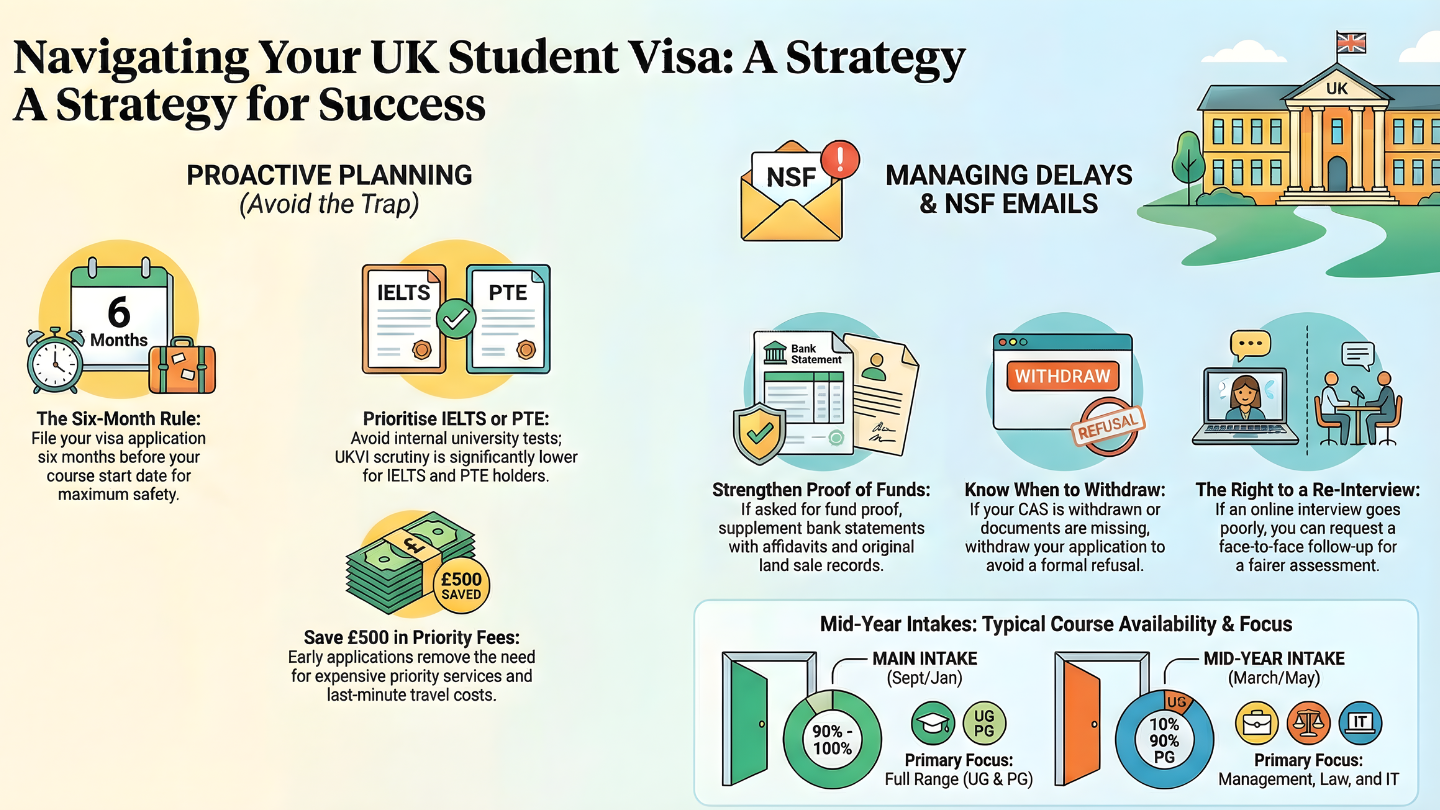
UK Student Visa Application: 5 Tips to Avoid NSF Emails

 
Navigating the UK student visa Application can feel like trying to solve a puzzle in the dark. You’re bombarded with jargon like CAS (your university’s ‘Confirmation of Acceptance’), SLA (the ‘Service Level Agreement’ for processing times), and NSF (the dreaded ‘Not Straightforward’ email), and the stakes couldn’t be higher. A single misstep can lead to delays, added costs, or a refusal that jeopardizes your entire academic future. It’s a journey where it’s easy to feel like a passive participant, simply waiting for a decision you can’t control.
 
This guide is designed to cut through that noise. It offers five non-obvious, strategic truths based on hard-won experience. These aren’t the standard tips you’ll find on a checklist. They are counter-intuitive insights that empower you to move from a passive applicant to a proactive strategist, taking control of your application and significantly increasing your chances of success.
 
1. The Strategic Withdrawal: Protecting Your UK Student Visa Application
Successful UK student visa application tips
If you receive a “Not Straightforward Form” (NSF) email from UKVI requesting proof of funds and you know your documentation is weak, the most strategic course of action is often to withdraw your application. This isn’t an admission of defeat; it’s a calculated decision to protect your long-term immigration history. This isn’t always about fake documents; often, genuine students simply don’t have meticulous records of past transactions.
 
From a strategic standpoint, a visa refusal is far more damaging to your record than a withdrawal. A refusal must be declared on all future applications, signaling a red flag to visa officers and making subsequent approvals much more difficult. A withdrawal, however, costs you the application fee but leaves your record clean. It allows you to regroup, prepare stronger documentation, and reapply for the next intake without the black mark of a rejection.
 
“It is much better to withdraw before a rejection. There is no major loss in a withdrawal… but if you get rejected, it will be much more difficult for you in the future.”
 
2. The Interview Do-Over: You Have the Right to Demand a Fair Assessment
 
Many students are unaware of their rights during the visa interview process. If you have an online interview and feel you performed poorly—whether due to technical glitches, confusing questions, or sheer nervousness—you do not have to passively accept the outcome.
 
At the end of the interview, the officer will ask if you are satisfied. This is your moment to take control. If you believe you didn’t get a fair chance, you have the right to state that you are not satisfied and formally request a new, face-to-face interview. Remember, you are a genuine student making a significant financial investment in UK education. You are not an uneducated person seeking a work permit; you are a valuable future asset, and the UK needs you. You are entitled to a clear, professional, and fair evaluation.
 
“You have the right to appeal. You can tell them, ‘No, I am not satisfied with this interview. I would like to come for a face-to-face interview.’ You should go to this extent.”
 
3. The Master’s Degree Trap: Your Course Choice Could Trigger a Rejection
 
A common mistake for students with technical backgrounds—like electrical engineering, computer science, or civil engineering—is choosing a generic master’s degree like “Business Management.” While widely available, this choice is a major red flag for visa officers, who are trained to spot illogical educational pathways.
 
The unwritten rule here is that your progression must make sense. Why would an engineer suddenly pivot to general business? This becomes a critical problem because interviews are becoming much more common. You can no longer hide behind paperwork; you must be prepared to verbally defend your choices. A vague link makes you a less credible applicant. Instead, choose a related management course that builds on your existing expertise, such as “Engineering Management.” This creates a logical, defensible career path that will stand up to scrutiny.
 
4. The English Test Hierarchy: Not All Approved Tests Are Equal
 
While UK universities might accept a wide array of English language tests for admission—including Duolingo, TOEFL iBT, Oxford Language, Medium of Instruction (MOI) letters, or their own internal tests—the UK Visas and Immigration (UKVI) authority does not view them all equally.
 
From a tactical perspective, opting for tests other than the most established ones puts your application under a microscope. Applicants with these alternative tests often face tighter scrutiny, stricter compliance checks, and a less smooth correspondence process with the visa office, adding unnecessary risk and potential delays. To ensure the smoothest possible journey and minimize compliance headaches, the safest and most recommended options are IELTS and PTE.
 
5. The “Too Early” Advantage: How Applying Early Protects Your Future
 
The common tendency is to wait until the last minute, but UK immigration rules allow you to apply for your student visa up to six months before your course starts. Taking advantage of this is one of the smartest strategic moves you can make.
 
Applying early helps you avoid the immense stress of last-minute priority visa fees (£500) and expensive flights. It also helps you avoid a system that becomes overloaded and prone to error during peak season, when agency teams are worn out, and glitches appear. Most importantly, it shields you from sudden, negative policy changes. For instance, a recent rule change directly impacts students right now: those who applied early for the September intake will have a two-year Post-Study Work (PSW) visa. However, for those going in the January 2026 intake, if they apply after December 31st, their PSW will be only 18 months. Applying early locks in the rules in effect at that time, protecting your future.
——————————————————————————–
Conclusion: From Applicant to Strategist
 
These five truths share a common thread: the UK visa system has pressure points and unwritten rules. By understanding them—knowing when to withdraw, how to challenge an unfair interview, or how to shield yourself from policy changes—you shift from a passive applicant to a strategist who is in control of their own destiny. Successfully securing your visa isn’t just about paperwork; it’s about being informed, proactive, and tactical.
 
Now that you know these insider strategies, what is the one proactive step you will take today to take control of your UK visa journey?